
South Korea stock market crash Over 5% as AI Chip Sell-Off Shakes Asian Markets
South Korea’s stock market suffered a sharp decline on Tuesday, October 13, as investors sold shares in major semiconductor companies.
The country’s benchmark Kospi index dropped more than 5%. The decline followed growing concerns about the outlook for artificial intelligence investments and increased competition in the global memory chip industry.
Samsung Electronics and SK Hynix were among the hardest-hit companies.
According to Associated Press, Samsung shares fell 7.4%, while SK Hynix declined 10.1% during the reported trading session.
The sell-off also affected other Asian technology markets, highlighting the importance of semiconductor companies to regional stock market performance.
Kospi Index Falls More Than 5%
South Korea’s Kospi index fell 5.5% to 6,035.35 during Tuesday’s trading.
Earlier in the session, the index had dropped more than 7%, briefly falling below the 6,000-point level.
The decline marked a significant reversal for a market that had benefited from strong investor interest in artificial intelligence.
In June, the Kospi reached a record high after crossing 9,000 points.
Demand for AI-related technology had helped support major South Korean companies. Investors were particularly interested in businesses supplying memory chips and other components used in advanced computing systems.
However, Tuesday’s decline showed how quickly market sentiment can change when expectations about future growth become uncertain.
Samsung and SK Hynix Shares Face Heavy Selling
Two of South Korea’s largest semiconductor companies experienced substantial losses.
Reported share-price declines — October 13, 2026
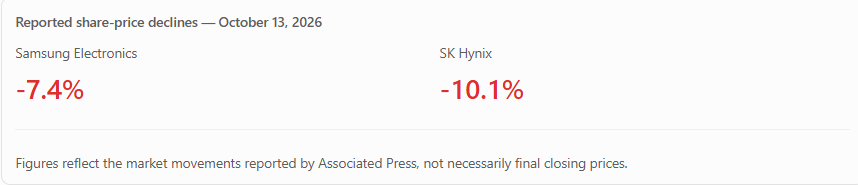
Figures reflect the market movements reported by Associated Press, not necessarily final closing prices.
Both companies play important roles in the global semiconductor supply chain.
Samsung produces memory chips and a wide range of electronic components.
SK Hynix is another major memory chip manufacturer. Its products are used in computing systems, including infrastructure supporting artificial intelligence.
Strong demand for advanced memory technology has attracted significant investor attention in recent years.
However, concerns about competition and future profitability have increased uncertainty around the sector.
China’s Memory Chip Industry Adds Competitive Pressure
One factor behind the sell-off was concern about technological advances by Chinese memory chip manufacturers.
Reports about developments at China’s CXMT raised questions about the competitive position of established memory chip producers.
Samsung Electronics, SK Hynix, and Micron Technology are among the world’s major memory chip suppliers.
Investors are assessing whether stronger competition could eventually affect market share, pricing, and profitability.
The concerns do not establish that Chinese manufacturers have already replaced the leading suppliers in advanced AI applications.
Instead, they reflect uncertainty about how competition may develop.
Semiconductor manufacturing requires advanced technology, significant investment, and complex production processes.
Changes in this industry can take time to affect commercial markets.
Why AI Chip Stocks Are Under Pressure
Artificial intelligence has become a major source of demand for advanced computing hardware.
AI systems require substantial processing power and memory capacity.
This has supported investment in semiconductor manufacturers, data centers, and related technology businesses.
However, investors are increasingly examining whether the expected financial returns will justify the scale of spending.
Technology companies have committed significant resources to expanding AI infrastructure.
If demand grows more slowly than expected, suppliers could face pressure on earnings forecasts.
Competition may also affect pricing and profit margins.
These uncertainties can lead to sharp movements in share prices, particularly after periods of rapid growth.
Tuesday’s market decline illustrates how sensitive semiconductor stocks have become to changes in AI-related expectations.
Asian Stock Markets Also Decline
The weakness in South Korean technology shares was accompanied by declines in other regional markets.
Japan’s Nikkei 225 fell approximately 1.8%, according to the Associated Press report.
Taiwan’s Taiex declined around 2%, while Taiwan Semiconductor Manufacturing Company shares also weakened.
However, not all Asian markets moved in the same direction.
Hong Kong’s Hang Seng and China’s Shanghai Composite recorded modest gains during the reported session.
These mixed results suggest that investors were responding to different economic and industry developments across the region.
South Korea’s particularly large decline reflected its substantial exposure to semiconductor companies.
Why Semiconductor Stocks Matter to the Global Economy
Semiconductors are essential components in modern technology.
They are used in smartphones, computers, vehicles, telecommunications equipment, industrial machinery, and artificial intelligence systems.
South Korea is one of the world’s leading producers of memory chips.
Changes affecting its semiconductor industry can therefore attract attention from businesses and investors worldwide.
For example, companies developing AI infrastructure depend on reliable supplies of advanced memory and processing components.
Major changes in semiconductor demand or pricing can influence investment decisions throughout the technology supply chain.
However, a stock market decline does not necessarily indicate an immediate disruption to chip production or deliveries.
Share prices reflect investor expectations, which can change faster than actual business operations.
How the Sell-Off Could Affect AI Investment
The market decline raises questions about the sustainability of recent AI-related investment growth.
Several technology companies have expanded their spending on data centers and computing infrastructure.
This spending has created demand for advanced semiconductors.
However, investors are paying closer attention to the relationship between infrastructure costs and future revenue.
If businesses continue expanding AI services, demand for specialized hardware could remain substantial.
On the other hand, slower adoption or weaker profitability could lead some companies to reconsider spending plans.
Both outcomes remain possible.
Tuesday’s market movements do not establish that AI investment is entering a prolonged downturn.
They do show that investors are becoming more sensitive to potential risks.
What Investors Will Watch Next
Several developments could influence semiconductor shares in the coming weeks.
Investors will be watching earnings reports and guidance from major chip manufacturers.
They will also assess announcements about new memory technology and production capacity.
Demand from data center operators and large technology companies will remain important.
Developments in China’s semiconductor industry may also influence expectations about future competition.
Broader economic conditions, including interest rates and international trade policies, could add further uncertainty.
For now, South Korea’s market decline highlights the close connection between global AI investment expectations and the performance of major semiconductor companies.
The next phase of the market will depend on whether business results support the growth expectations that have driven AI-related investment.